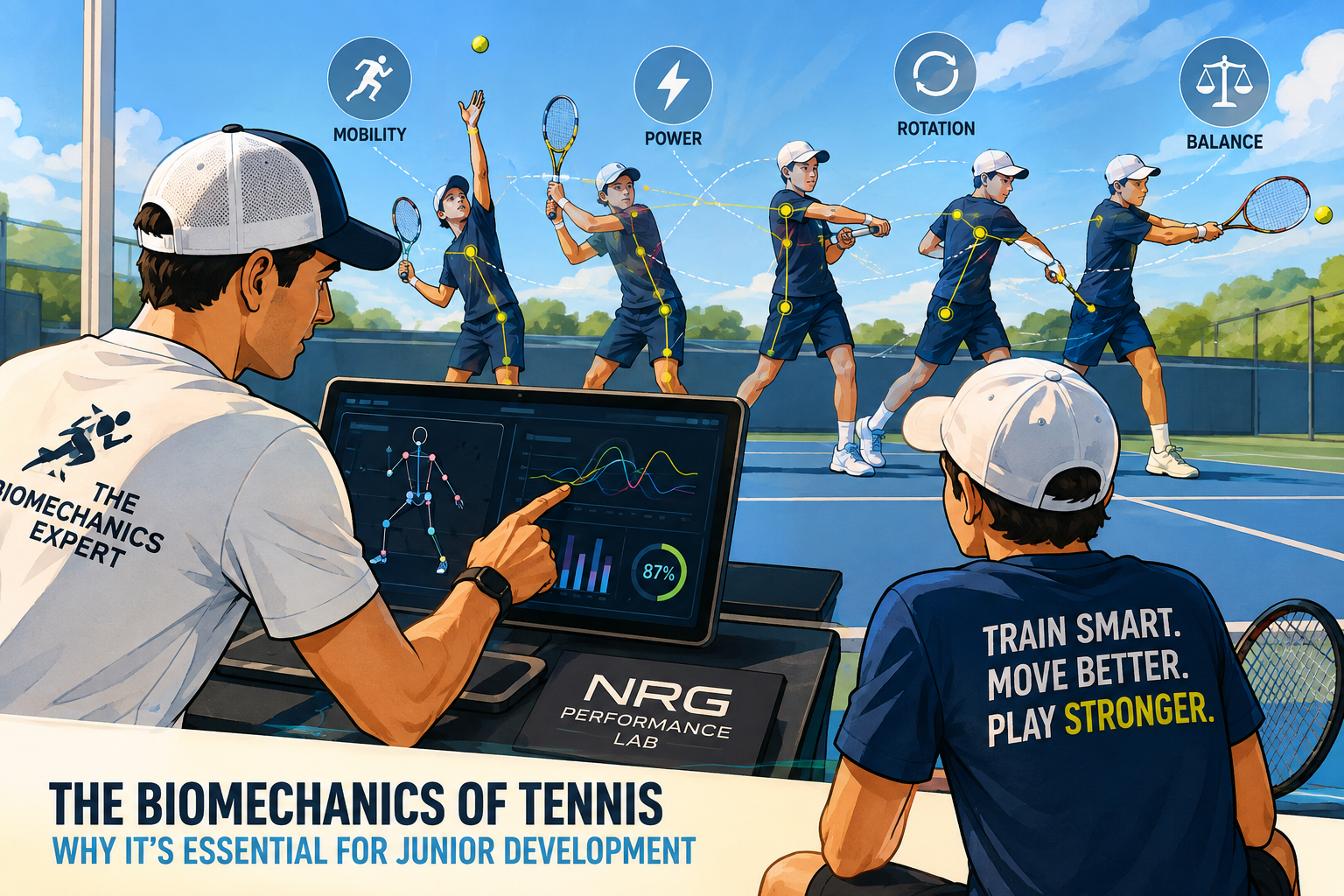

In the pursuit of more power, spin, or reach, it’s tempting to think that pushing a joint a little further, twisting a little harder, or stretching a stroke beyond its natural range will translate into better results on court. In reality, forcing joints past their functional limits to achieve a technique is one of the most common and preventable causes of injury in tennis and other rotational sports. Understanding why this happens, and how to recognize it, is essential for players, coaches, and parents alike.
What “Forcing” a Joint Actually Means
Every joint has a natural, healthy range of motion determined by its bone structure, ligaments, tendons, and surrounding musculature. Good technique works within that range, using timing, sequencing, and rotation from multiple joints together to produce force efficiently. Problems begin when a player, often unconsciously, tries to generate extra power or reach by pushing a single joint beyond where it moves comfortably and safely.
This can look like:
- Hyperextending the elbow or wrist to add “whip” to a shot
- Overrotating the shoulder past its stable range on the serve
- Twisting the lower back excessively to compensate for limited hip rotation
- Locking the knee at full extension during a lunge or split step
In the short term, these compensations can sometimes produce a marginal gain in power or spin. Over time, however, they place repeated stress on tissues that were never designed to absorb that kind of load.
Why Deforming Technique Leads to Injury
1. Ligaments and Tendons Aren’t Built for Repetition Beyond Range
Ligaments stabilize joints; tendons transmit force from muscle to bone. Both have a limited capacity to stretch and recover. When a joint is repeatedly pushed to or past its end range, these tissues absorb micro-trauma that doesn’t fully heal between sessions. Over weeks and months, this accumulates into conditions like tendinopathy, ligament laxity, or joint instability.
2. The Body Compensates in a Chain Reaction
Joints don’t work in isolation. When one joint is forced beyond its natural range, nearby joints and muscles often compensate to keep the overall movement functional. A shoulder that’s overrotated, for example, can shift stress onto the elbow or the lower back. This is why an injury often shows up somewhere other than the joint that was originally being overused, making the root cause harder to identify without a proper biomechanical assessment.

3. Cartilage Damage Accumulates Silently
Unlike muscle soreness, cartilage wear often produces no clear symptoms until damage is significant. Repeated joint loading beyond a safe range, especially in the knees, hips, and spine, can contribute to early cartilage breakdown that isn’t felt until pain or stiffness eventually appears, often years later.
4. Growing Bodies Are Especially Vulnerable
For junior athletes, growth plates and developing connective tissue are more susceptible to this kind of stress than a fully mature adult body. A technique that seems to work in the short term can create long-term structural issues that only become apparent as the athlete matures and training volume increases.
Common Warning Signs
- Joint pain that appears consistently after certain shots or drills, not from a single incident
- A feeling of “clicking,” instability, or looseness in a joint during play
- Reduced range of motion or stiffness that develops over a season
- Asymmetry between the dominant and non-dominant side that keeps increasing rather than stabilizing
These signs often appear gradually, which is exactly why they’re easy to dismiss until the injury becomes serious enough to interrupt training or competition.
How to Build Power Without Forcing the Joints
The good news is that generating more power, spin, and reach doesn’t require pushing any single joint past its safe range. Real gains come from improving how joints work together:
- Sequencing over strain. Power should be built through the kinetic chain, ground force through the legs, rotation through the hips and trunk, and only then the arm, rather than isolated joint effort.
- Mobility work. Improving natural range of motion in the hips, shoulders, and thoracic spine reduces the need to compensate with excessive joint stress elsewhere.
- Strength through full, controlled range. Building strength within a joint’s healthy range makes it more stable and resilient, rather than relying on passive stretching under load.
- Technical assessment. A biomechanical evaluation can identify exactly which joint, if any, is being pushed beyond a safe range, and correct the underlying pattern before it becomes an injury.

The Bottom Line
Technique that relies on deforming a joint, pushing it past its natural, stable range to manufacture extra power or reach, tends to trade short-term performance for long-term injury risk. The joints, ligaments, and tendons involved simply aren’t designed to absorb that kind of repeated stress. Sustainable power comes from efficient movement across the whole kinetic chain, not from forcing any single joint to do more than it was built to handle. Identifying and correcting these patterns early, especially in developing athletes, is one of the most effective ways to protect a player’s long-term health and performance.