What makes the Next-Gen forehand different:
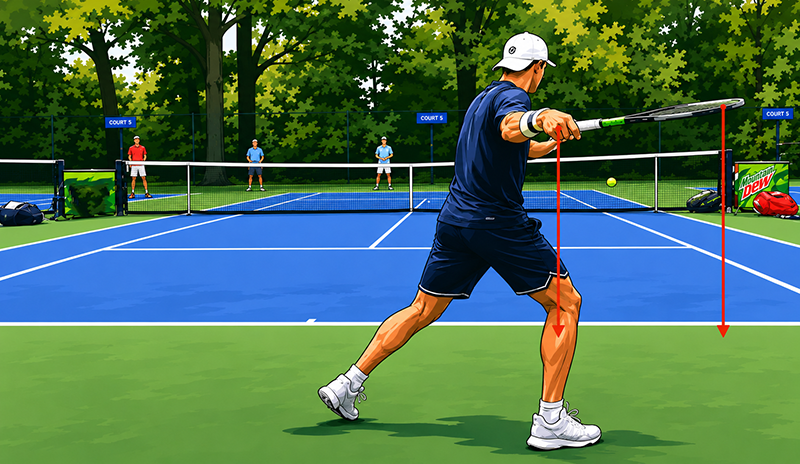
The defining characteristic of the Next-Gen forehand is the combination of extreme topspin with high ball speed — two qualities that were traditionally considered to be in tension with each other. Previous generations of players had to choose between a flatter, faster ball or a heavier, slower one. The new generation has eliminated that trade-off entirely. By making contact at a significantly higher point in the ball’s bounce — often at shoulder height or above — and generating racket head speed through an aggressively accelerated kinetic chain, these players produce a ball that arrives deep, kicks high, and pushes opponents far behind the baseline. The margin for error is smaller, but the pressure generated is overwhelming.
The biomechanics behind the shot:
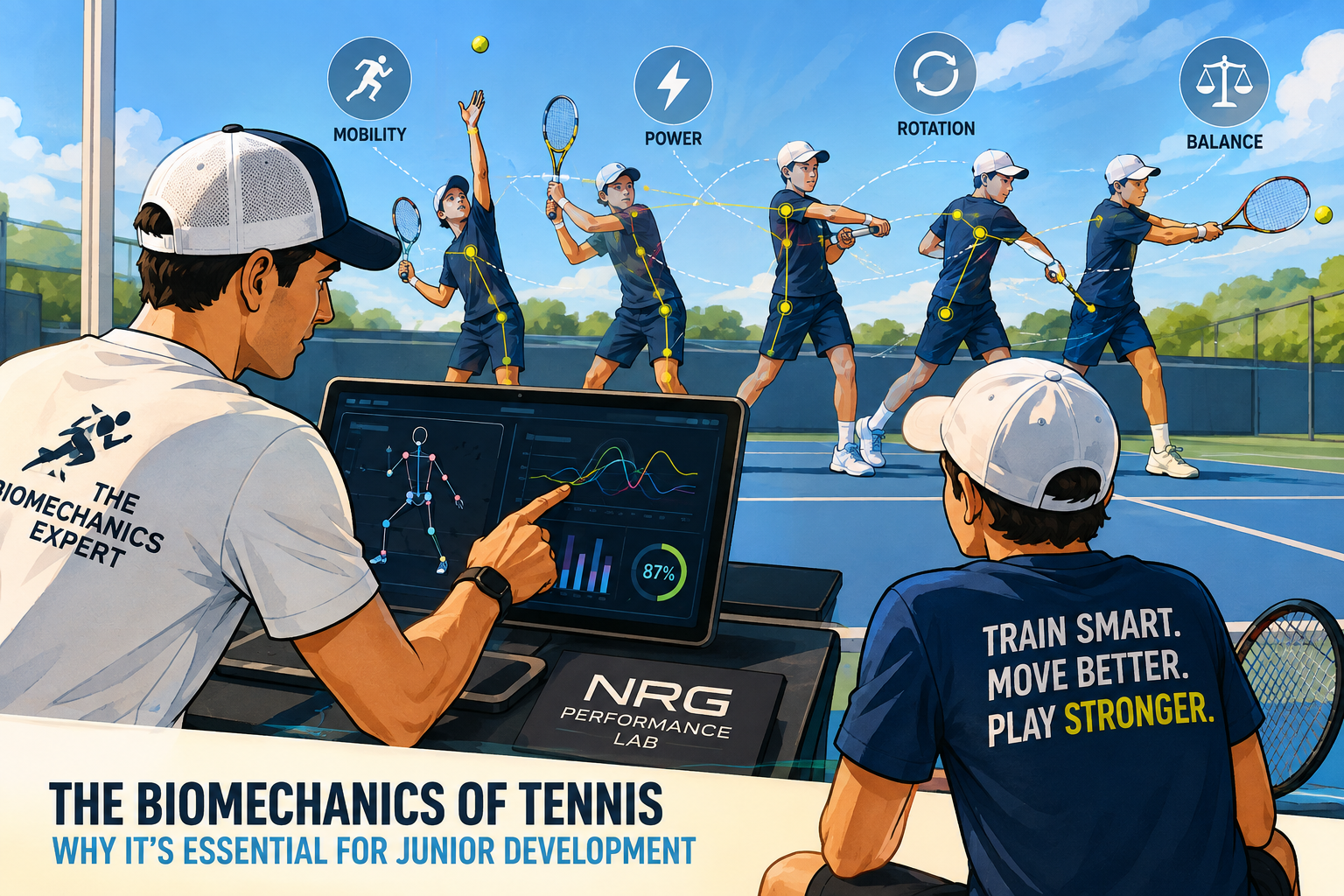
What separates this forehand from a purely technical standpoint is the role of hip and trunk rotation. Next-Gen players initiate the stroke from an extremely closed stance, loading the hips aggressively before rotating explosively through the point of contact. This rotational force — generated far from the arm — is what creates the whip-like acceleration of the racket head in the final milliseconds before impact. The wrist adds a final layer of pronation and snap that applies topspin without sacrificing forward momentum. Every joint fires in the correct sequence, at the correct moment, with no energy wasted. It is a masterclass in kinetic chain efficiency.
Why it matters for the near future:
As this generation ascends to the top of the rankings and their style becomes the dominant template for professional tennis, the sport at every level will adapt accordingly. Junior academies, national programs, and elite coaches are already restructuring their development models around these movement patterns. Players who cannot handle high, heavy balls hit to their backhand side — or who cannot generate comparable topspin and pace from their own forehand — will find themselves structurally disadvantaged in professional competition within the next five years. The baseline has shifted, and the margin between those who adapt and those who do not will only widen.
The physical demands and injury implications:
The biomechanical demands of the Next-Gen forehand are considerable. The extreme hip loading, aggressive trunk rotation, and high-contact-point impact create forces that require exceptional core stability, hip mobility, and shoulder integrity to sustain over a full match and a long season. Players who attempt to replicate this style without the physical foundation to support it risk overuse injuries — particularly to the shoulder, elbow, and lumbar spine. This is a critical area where biomechanical screening becomes invaluable. Before any player commits to developing this stroke at high intensity, a thorough movement assessment must confirm that the body is prepared to absorb and generate those forces safely and repeatedly.
Building it the right way:
Developing a Next-Gen forehand is not simply a matter of watching footage and trying to imitate what the top players do. The movement patterns are deeply integrated — they depend on footwork, body position, timing, and physical conditioning working in perfect synchrony. At The Biomechanics Expert, we approach this development systematically. We begin with a full biomechanical assessment to understand the player’s current movement baseline, identify any physical limitations that need to be addressed first, and then construct a progressive training plan that builds the stroke from the ground up — starting with the kinetic chain and working outward to the arm and racket. The result is a forehand that is not only more powerful and consistent, but structurally sound enough to perform under the full demands of competitive play.
The Next-Gen forehand is not a trend — it is the future of professional tennis. The players who understand its biomechanical foundations, invest in developing the physical attributes it demands, and train it with scientific precision will be the ones competing at the highest levels of the game in the years ahead. The question is not whether to adapt. The question is how soon you start.